











Wareham gets grants to plan removal of Parker Mill dam, evaluate sewer system weaknesses
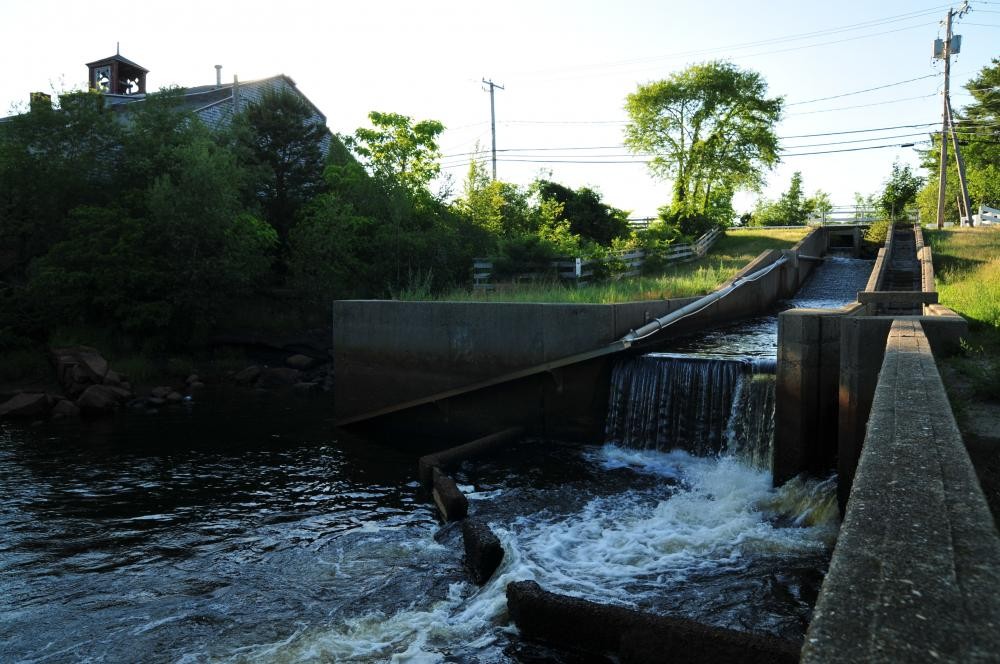
The Town of Wareham received two grants worth $361,000 from the Massachusetts state government to devise a plan to remove the Parker Mills Pond Dam and to study weaknesses in the sewer system.
The grants are part of a statewide effort to improve resilience to climate change. The Executive Office of Energy and Environmental Affairs will contribute over $45 million to 97 projects across the state through its Environment & Climate One Stop program.
One grant, worth $250,000, is focused on creating an engineering design to remove the Parker Mills Pond Dam. The Executive Office of Energy and Environmental Affairs said that removing the dam “would eliminate the risk of future dam failure causing catastrophic flooding” in the Tremont Nail Factory District or downtown Wareham.
Wareham Department of Planning and Community Development Director Joshua Faherty said the funds will be used to come up with “full-on design concepts” to remove the dam. “It basically gets us shovel-ready to remove the Parker Mills Dam,” he said.
Under the current plan, according to Faherty, the dam will be fully removed and a fish ladder will be installed to allow migratory fish to traverse the elevation difference between Parker Mills Pond and the Wareham River.
Removing the dam would also make developers feel more comfortable with redeveloping the Tremont Nail Factory. “We’ve had interest from people coming in to redevelop that property, but no one will do it with the risk associated with the dam,” Faherty said.
The town received a $642,000 federal grant in 2026 to begin preliminary studies in January to remove it. However, Faherty said that the town could not access those funds until it was matched by a state grant.
Faherty said that consulting firm Fuss and O’Neill, which the town hired for this project in 2022, quoted the removal project at $1 million. He said the town asked the state government for a grant to match the difference and access the federal money.
The town now has a budget of $892,000 to craft the engineering plan. He told the firm that the town likely won’t provide any additional money, so the consultants will have to adjust the plan to work with the existing budget.
Faherty said he could not provide a timeline until Fuss and O’Neill provided the redesign.
Downing the dam has been a years-long ordeal. It has been classified as a high hazard potential dam since 2014 due to the risk of it failing and flooding parts of Wareham. The structure’s poor state has caused Elm St. to be closed for years. Faherty said that Elm St. will likely remain a pedestrian-only street.
An ownership dispute with cranberry grower A.D. Makepeace, which led to the town suing the company in 2018, stymied progress. Makepeace claimed the town owned 25 percent of the dam. The town dropped the lawsuit in 2019.
The other grant of $111,000 will be used to study coastal hazards that can affect both current and future sewer infrastructure. If the town finds any areas that are susceptible to flooding or other threats, it will come up with one or two alternative designs or siting options, according to the project description.
Wareham Sewer Department Director Scott Kraihanzel, said that addressing these vulnerabilities is a “necessary cost” for a coastal town like Wareham. “This is something that is exceptionally important,” he said.
Many of the system’s lift stations, which raise water from lower to higher elevations, are in flood zones, Kraihanzel said. The Sewer Department will use the grant money to address vulnerabilities such as those.