











Town receives over $600,000 for preliminary studies to remove Parker Mills Pond Dam
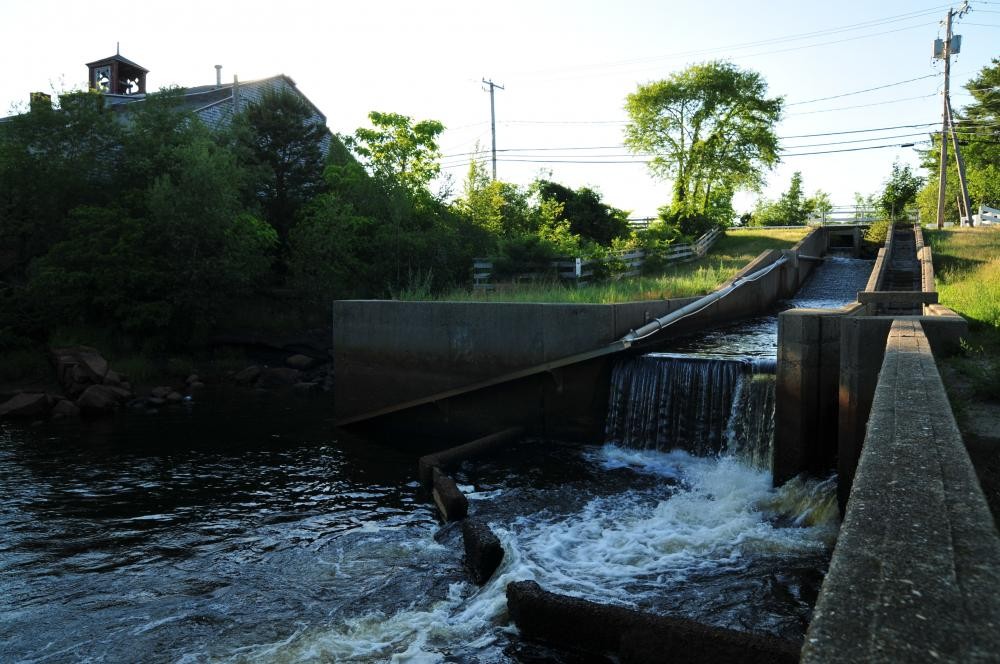 The spillway of the Parker Mills Pond Dam. File photo
The spillway of the Parker Mills Pond Dam. File photo
The spillway of the Parker Mills Pond Dam. File photo
The town received a $642,200 state grant to be used for preliminary studies before removing the Parker Mills Pond Dam.
The dam, located in the Wareham River across from the former Tremont Nail Factory, has closed Elm Street and been classified as a high hazard dam by the state Office of Dam Safety since 2014.
According to a 2014 Wareham Week report, the state told the town the dam “faces a multitude of repairs in order to maintain public safety” and the dam has “displaces and unstable upstream wall sections, sinkholes and leakage . . . and deterioration of concrete.”
In 2018, the town entered into litigation with A.D. Makepeace over ownership of the dam. The town claimed the cranberry grower owned 25% of the dam while Makepeace claimed the town owned all of it.
While the suit was eventually dropped, the question of ownership remains unanswered. According to director of planning and community development Josh Faherty, he does not see ownership questions impacting the project or grants.
This is the second grant the town has received for this project. The first was a $187,000 state grant to help pay for the design costs and Faherty said the project moving forward will be funded by state grants.
The preliminary studies include various environmental tests including assessing any potential pollution left behind from the Tremont Nail Factory and estimating what the river could look like once the dam is removed.
One of the main questions Faherty said needs to be answered before any construction, which he expects to be two-to-three years away, is how removing the dam will impact the bridge over Route 28.
Faherty explained when the dam gets removed, the water level near the bridge will drop and there will be a heavier flow of water rushing past the bridge abutments, the structures that hold the bridge up.
He added the studies are looking at the depth of abutments. Faherty said if the abutments are not deep enough, the increased flow of water and lower water level could remove sediment around the abutments, posing a risk to the bridge.
“When the bridge was built there was no turbidity around the abutments but when we take the water level down, the river could wash out underneath the abutments if they aren’t deep enough,” he said. “We don’t want to undermine a highway bridge.”
Other questions Faherty said the preliminary studies will look into is “stream channeling.” He said part of the design will include an estimation of how the water will flow once the dam is removed and constructing a fish ladder to help the various species of fish travel through the river.
Removing the dam not only solves a public safety issue, but it also poses more opportunity for redevelopment. Faherty said one of the biggest challenges the town faces in repurposing the Tremont Nail Factory right now is the dam.
“The position of any developer is that the removal of the dam makes it a safe property that could be re-vitalized,” he said. “We’re working on a kind of two step approach here.”
Faherty added the town has communicated with cranberry growers near the dam who said removing it would not pose a threat to their operation.